AI and Machine Learning are transforming how top tech companies develop their products, automate processes, and solve business challenges. From recommendation engines in e-commerce applications, fraud prevention in banking, to code auto completion using AI & machine learning is becoming an indispensable part of modern software development.
According to the World Economic Forum's Future of Jobs Report 2025, AI and Big Data are two of the most rapidly growing skills that will become highly demanded by 2030. The demand will create new job opportunities for people who will be able not only to write code but also to develop intelligent systems.
For engineers and working professionals, who are planning their future career moves, 2027 would be an appropriate period to get practical skills in Machine Learning and Generative AI.
However, where should you start? Should you learn Python, math, machine learning algorithms, deep learning, or Generative AI?
The following ML Engineer Roadmap 2027 will guide your learning process step-by-step from the most basic concepts to tools, projects, and interview preparation for becoming a Machine Learning Engineer in the industry.
What Does a Machine Learning Engineer Do?
A Machine Learning Engineer creates, designs, trains, and implements machine learning algorithms that enable applications to make predictions and decisions based on data.
Unlike in traditional software development, where developers create detailed instructions, machine learning engineers develop systems that learn patterns from historical data and get better at what they do through training.
Some examples of work for ML Engineers include:
- Developing recommendation systems to provide appropriate recommendations.
- Developing fraud detection systems to detect fraudulent activities.
- Building search engines that understand the intent of the users.
- Building predictive models to predict behavior of customers.
- Implementing AI applications that utilize Large Language Models (LLMs).
An ML Engineer requires a combination of programming skills, mathematical background, machine learning knowledge, and software engineering skills.
Machine Learning Engineer Roadmap 2027: Skills and Learning Journey
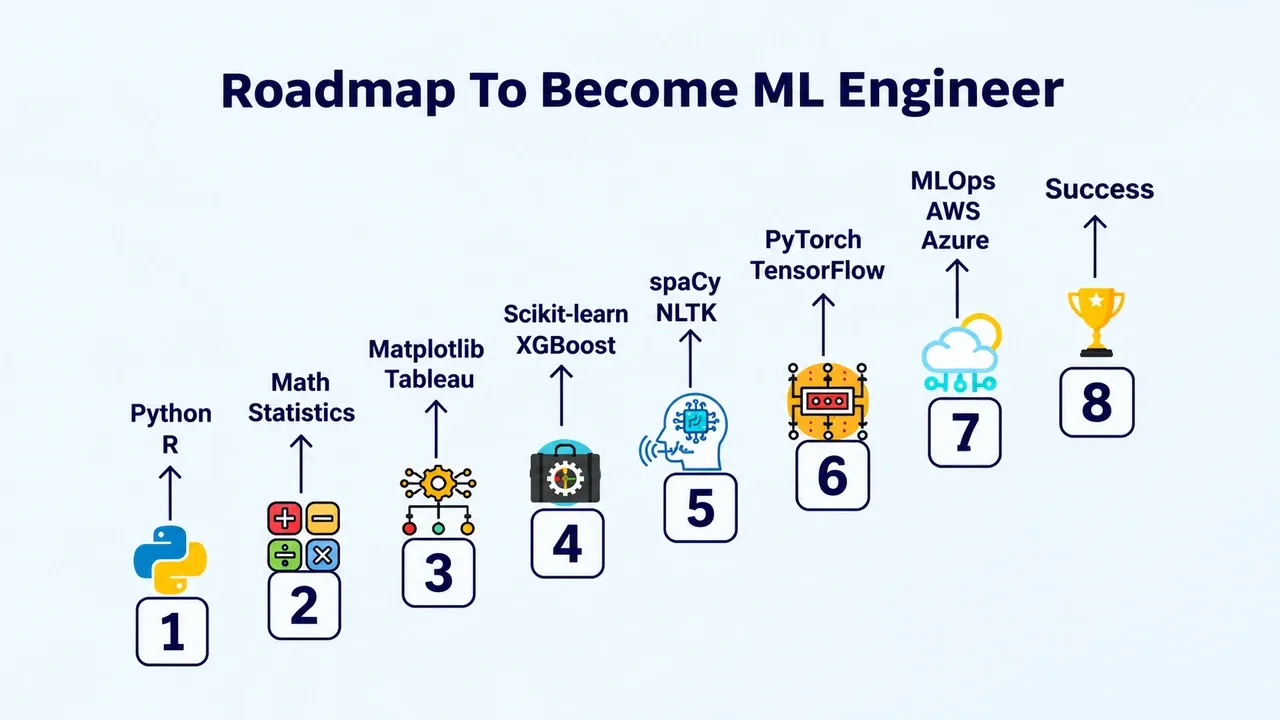
Below is an outline of the skills that you need to learn to be a Machine Learning Engineer.
| Learning Stage | Skills to learn | Tools for learning |
|---|---|---|
| 1. Programming | Python, OOP, DSA, SQL | Python, Git, MySQL |
| 2. Mathematics | Statistics, Probability, Linear Algebra | NumPy, SciPy |
| 3. Machine Learning | Supervised and Unsupervised Learning | Scikit-learn, XGBoost |
| 4. Deep Learning | Neural Networks, CNNs, Transformers | PyTorch, TensorFlow |
| 5. Generative AI | LLMs, RAG, Embeddings, AI Agents | Hugging Face, LangChain |
| 6. MLOps | Deployment, Monitoring, Model Pipelines | Docker, MLflow, FastAPI |
| 7. Projects & Interviews | End-to-end projects, system design | GitHub, Cloud Platforms |
Let us analyze each step in detail.
1. Learn Python, Programming and SQL Fundamentals
Python is among the most popular programming languages in the field of Machine Learning due to its easy-to-understand syntax and rich library.
Start with developing your programming skills before you move on to machine learning algorithms.
Important topics to study include:
- Python basics, functions, loops and data structures.
- Object-oriented programming.
- Exception handling and file operations.
- Data Structures and Algorithms.
- SQL queries, joins, aggregations, and sub-queries.
- Git and GitHub for version control.
Tools to master: Python, NumPy, Pandas, Git, and MySQL.
Project idea: Develop a sales data analysis application in Python that would load data sets, clean them from missing values, perform SQL queries and derive business insights.
2. Strengthen Your Mathematics and Statistics Foundation
You don’t have to know everything about mathematics to become an ML Engineer. But knowing how mathematics works behind machine learning algorithms can help you make better choices during the process of building models.
Concentrate on these topics:
- Linear Algebra: vectors, matrices, matrix multiplication, and eigenvalues.
- Probability: conditional probability, Bayes’ theorem, and probability distributions.
- Statistics: mean, median, variance, standard deviation, and hypothesis testing.
- Calculus: derivatives, gradients, and optimization.
- Gradient Descent: the way models minimize errors during the process of learning.
For example, linear algebra helps represent datasets and embeddings, while statistics allows determining the reliability of a model’s predictions.
Your main aim is to learn these concepts as a part of practical applications of ML and not memorize mathematical formulas.
3. Learn Core Machine Learning Algorithms
This is where you start building actual machine learning models.
Machine Learning algorithms enable computers to recognize patterns in the datasets and predict outcomes without programming each decision step-by-step.
There are three core types of Machine Learning you need to be aware of:
| Type | What It Does | Application Example |
|---|---|---|
| Supervised Learning | Learning from labelled datasets | Spam detection and price forecasting |
| Unsupervised Learning | Recognizing patterns in unlabelled datasets | Customer segmentation |
| Reinforcement Learning | Learning from actions and rewards | Robotics and Game AI |
Core algorithms to master:
- Linear and logistic regression.
- Decision trees and random forest.
- Support vector machines (SVM).
- K-nearest neighbors (KNN).
- K-means clustering.
- Gradient boosting and XGboost.
- Principal Component Analysis (PCA)
Also need to know what is feature engineering, model evaluation, cross-validation, overfitting, and underfitting.
Programming tools: Scikit-learn, Pandas, Matplotlib, and XGboost.
Real-world application: Customer Churn Model which predicts customers who would leave a service.
4. Move Towards Deep Learning & Neural Networks
After getting a grasp on the traditional machine learning, the next topic of focus would be deep learning.
Deep learning uses multiple layers within neural networks in order to detect the complex patterns from big datasets. Applications range from things like facial recognition systems to speech recognition, image classification, and even language models.
Begin with:
- Artificial Neural Network (ANN).
- Convolutional Neural Networks (CNN).
- Recurrent Neural Networks (RNN).
- Transformers/Attention mechanism.
- Back Propagation & Optimization.
- Transfer Learning.
Recommended frameworks:
- PyTorch.
- TensorFlow.
- Keras.
- Hugging Face.
You do not have to know all the software listed above. PyTorch is recommended. Just know how neural networks are trained, tested, and optimized.
Practical project: Create a system which will classify images into different classes using a CNN model.
5. Learn Generative AI, LLMs and AI Agents
By 2027, it might be insufficient to learn only the basics of ML if you aim at a career in modern AI engineering.
Generative AI has broadened the scope of ML engineering. Businesses create applications capable of generating content, understanding documents, answering questions, and automating multi-step workflows.
Learn these key topics:
- Large Language Models (LLMs): Learn how models like GPT and open-source language models work.
- Prompt Engineering: Learn how to write prompts to get better results from models.
- Retrieval-Augmented Generation (RAG): Learn how to connect LLMs with external data sources to generate context-aware answers.
- Vector Databases: Learn about embeddings, similarity search, and semantic retrieval.
- Fine-tuning: Learn how pretrained models can be fine-tuned for particular tasks.
- AI Agents: Learn how to build systems capable of using tools, accessing information, and performing multi-step tasks.
Tools to check out: Hugging Face, LangChain, LangGraph, FAISS, ChromaDB, and LLM APIs.
Project idea: Build a document-based AI assistant capable of reading PDFs, extracting information from them, and answering questions with citations.
For a deeper understanding, read our guide on How to Become an AI Engineer.
6. Learn MLOps and Deploy Models
Creating a model in a Jupyter Notebook is not an end goal of itself. In reality, ML engineers should know how to deploy, track, and maintain models in production.
Here is when MLOps comes into play.
Key topics to cover:
- Model deployment with FastAPI or Flask.
- Containerization with Docker.
- Experiment tracking with MLflow.
- Model and dataset versioning.
- CI/CD pipelines.
- Model monitoring and data drift detection.
- Platforms like AWS, Azure, or GCP.
To give an example, one can build a model that detects fraud in the bank's application. Such model needs to take new transactions, make predictions fast, and be robust enough despite changing behaviour of customers.
Knowledge of MLOps will allow you to create scalable applications from experimental models.
7. Create Industry-Relevant Machine Learning Projects
Projects are one of the most effective tools you can use to showcase your practical skills to recruiters.
Rather than creating numerous simple projects, concentrate on building a few end-to-end projects that tackle business issues.
Here is a list of 5 project ideas to add to your portfolio of ML Engineer:
| Project | Skills Demonstrated |
|---|---|
| Customer Churn Prediction | Classification, Python, Scikit-Learn |
| Product Recommendation System | Collaborative Filtering, Ranking |
| Fraud Detection Solution | XGBoost, Feature Engineering |
| AI Document Helper | LLMs, RAG, Vector DBs |
| ML Predictions Real-Time API | FastAPI, Docker, MLOps |
When working on each of these projects, make sure you:
- Describe the business challenge.
- Outline your data set and methodology.
- Evaluate different models and metrics.
- Publish your clean and reproducible code on GitHub.
- Deploy at least one of these projects.
- State limitations and potential improvements.
A project that showcases your full process from data gathering to deployment may be more useful than a collection of several unfinished projects in your repository.
How to Prepare for ML Engineer Jobs at Product-Based Companies
Learning ML is only a portion of your preparation for a successful career ahead. In addition, if you wish to be a part of product-based firms, then apart from ML learning, it's also essential to build your skills in engineering and problem-solving.
You should concentrate on the following:
- DSA and Problem Solving: Practice Arrays, Strings, Trees, Graphs, Dynamic Programming, and other common concepts.
- Fundamentals of ML: Algorithms, Model Evaluation, Feature Engineering, and Optimizations.
- System Design for ML: Learn how to design ML Recommendation systems, ML Fraud Detection Pipeline, and ML Real-Time Prediction Service.
- GenAI and LLM Engineering: Learn RAG Architecture, Embeddings, Fine-tuning, and Evaluation of LLM.
- Project Discussion: Be ready to discuss your technical decisions, architecture, challenges, and trade-offs.
- Behavioral Interview: Be ready to discuss your problem-solving experience.
If you are a working professional, then this could be your guide to learning.
How Bosscoder Academy Can Help Working Professionals Become ML Engineers
If you are a software engineer or working professional who plans on becoming an ML Engineer, learning using multiple tutorials can hinder your progress.
The Bosscoder Academy GenAI & ML Engineer Program is tailored to help working professionals gain hands-on expertise for contemporary AI and ML jobs, more specifically for product tech companies.
It also focuses on technical interview preparation to help professionals strengthen their engineering fundamentals and prepare for competitive opportunities.
Expert guidance can make a difference during this journey. Read more about AI/ML mentorship for working professionals to understand how industry experts can help professionals prepare for AI/ML career opportunities.
Common Mistakes to Avoid While Following an ML Engineer Roadmap
While studying Machine Learning, a number of learners and even working professionals commit mistakes that slow their progress.
Here are some common mistakes you should avoid while using the ML engineer roadmap:
- Ignoring programming fundamentals: Learn Python and SQL before advancing further.
- Learning theory only: Try to apply all important concepts via practical assignments.
- Neglecting deployment process: Learn how to deploy your model beyond notebooks.
- Going straight to GenAI: Learn the basics of traditional machine learning and deep learning.
- Creating projects without documentation: Explain your approach, results, and technology used.
- Overlooking DSA and system design: It is very important to have them when getting ready for interviews of companies based on products.
- Learning many tools simultaneously: First of all, learn concepts.
Conclusion
Being a Machine Learning Engineer in 2027 means being much more than knowing a bunch of algorithms or enrolling in an online course. You will have to be proficient with programming, mathematics, machine learning, deep learning, Generative AI, and even production engineering.
Start from Python and basic statistics, slowly shift to ML and neural network algorithms, and explore LLMs, RAG, AI agents, and MLOps as well. And most importantly - start building some projects that prove you can solve some real problems.
If you want a structured learning path with practical projects, mentorship, and industry-focused interview preparation, explore the Bosscoder Academy GenAI & ML Engineer Program and take the next step towards your AI/ML engineering career.
The best roadmap is the one that you stick to.
Frequently Asked Questions About ML Engineer Roadmap 2027
Q1. How do I become a Machine Learning Engineer in 2027?
First, learn Python, SQL, math and stats. Then progress to machine learning algorithms, deep learning, Generative AI, and MLOps. Do projects and practice technical interviews to gain industry-ready skills.
Q2. How much time does it take to become a Machine Learning Engineer?
Usually, it takes about 6-12 months for people who know programming to establish themselves well in terms of education and experience, depending on the speed and experience of learning. For beginners, it will be 12-18 months or even more.
Q3. Is Python sufficient to become a Machine Learning Engineer?
No. Python is a very important language but you also need to know math, stats, machine learning algorithms, deep learning, SQL, and model deployment to be an ML Engineer.
Q4. Is DSA important for Machine Learning Engineer interviews?
Yes. Many product-based companies test coding skills apart from the machine learning knowledge. Knowledge of arrays, strings, trees, graphs, dynamic programming, and time complexity will be helpful.
Q5. Can Bosscoder Academy help working professionals become Machine Learning Engineers?
Yes. The Bosscoder Academy GenAI & ML Engineer Program is designed for working professionals who want to build skills in Machine Learning, Deep Learning, Generative AI, LLMs, and AI engineering. It combines structured learning, hands-on projects, mentorship, and interview preparation to help professionals prepare for AI/ML engineering opportunities, including roles at product-based companies.